Why is it that dogs behave so differently with different people? The simple answer is that dogs are people-pleasers at their very core, and willing to adjust to the demands of their environment. With that in mind, it makes sense that they would mold their behavior to accommodate the likes and habits of their humans, large and small.
It’s certainly true in our household and has been for a very long time, no matter who our canine family members are. When we had our beloved Toby—a burly chocolate Lab, he would bring his giant tug rope to my husband, Rob, in a not-so-subtle hint (demand) to play. And it worked every time. A rowdy game of pull and tug would follow that served them both. Toby got to tug and Rob got some core training and a good shoulder workout. Toby never brought a tug rope to me. His behavior toward me was to pander for a good scratching and to roll onto his back to present his irresistible pink belly for a rub. Yes, it worked every time. For Mollie, our beautiful black Lab, it was all about the game of fetch. She could not get enough. Frankly, she didn’t care who did the throwing, as long as she got to fetch. I used a Chuck-it to try to get the most out of each throw. The Chuck-it also spared me from having to touch the increasingly spit-soaked tennis ball between throws. It hung by the back door and whenever we picked it up, she pranced and wagged and wiggled all over in anticipation. Her behavior toward us was not equal, though. She was Rob’s dog all the way and she didn’t even pretend to prefer my company. They were both pretty smug about it too.
“The contrast between Daisy’s behavior with my husband and with myself is so blatant that it’s a household joke.”
When our kids were little, the dogs behaved gently around them and with such tolerance for being stepped on or pulled on clumsily. We taught our kids to be gentle around animals, but toddlers are unpredictable. We never had a misstep from our pups and, in fact, they seemed to enjoy being used as a pillow.
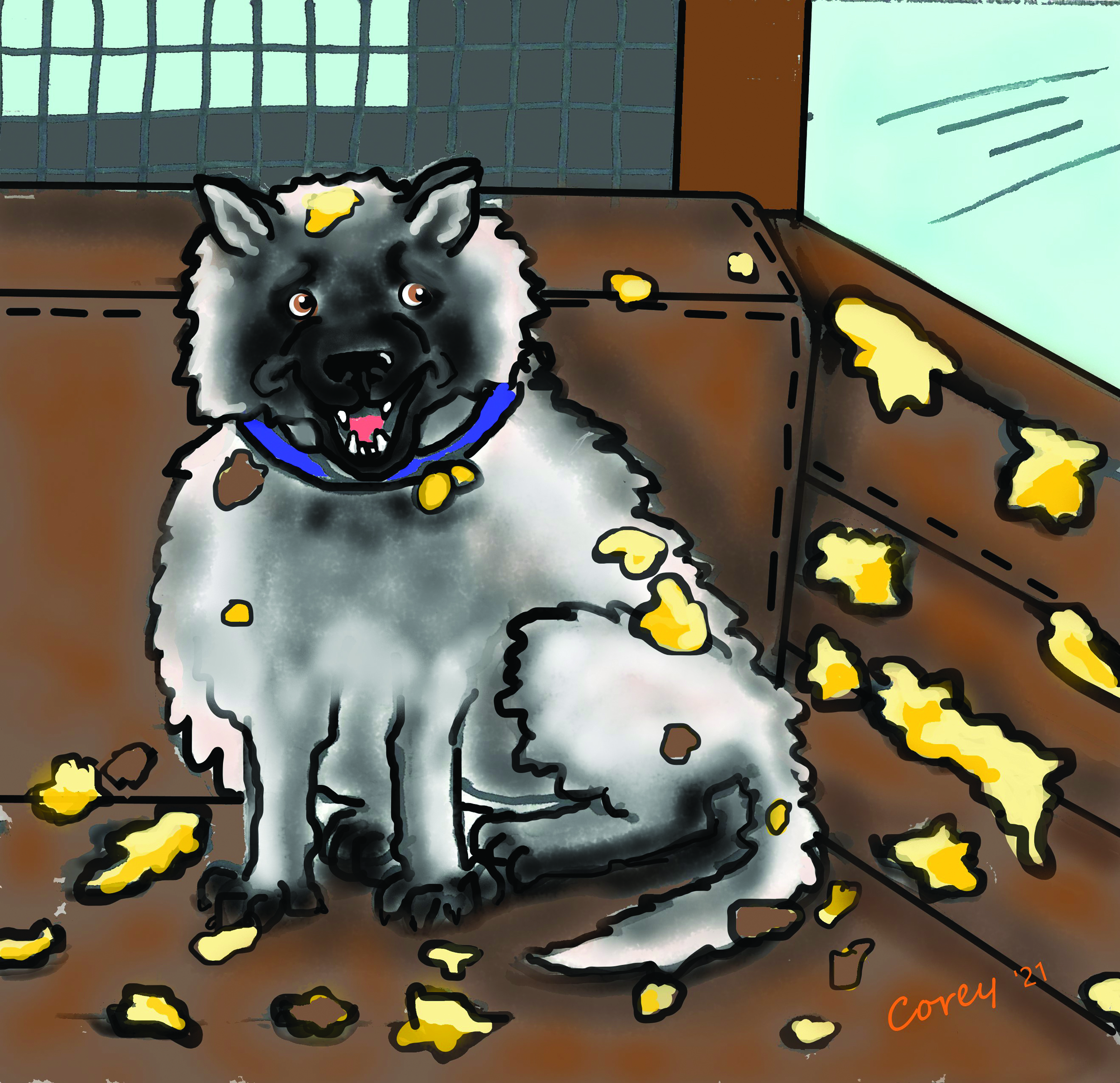
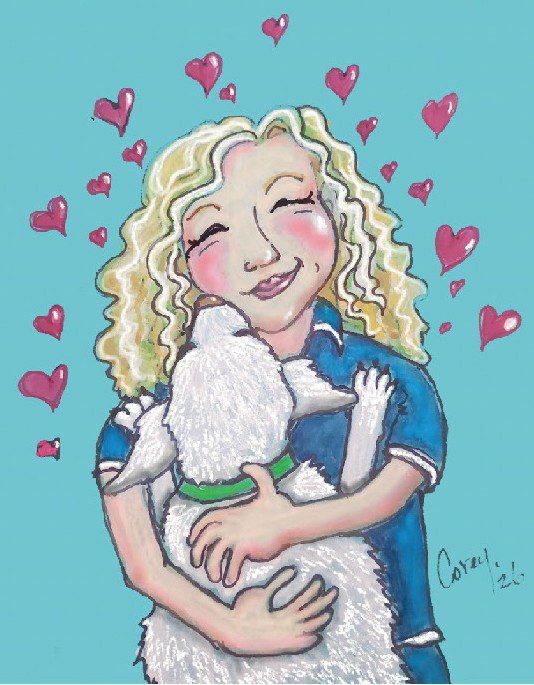
And now we have Daisy, a white rescue dog with black eyeliner and lipstick markings and a curled tail. She does not fetch. If we throw a toy or ball, she just looks at us as if to say, “You gonna get that or what?” She also does not tug. If you pull on a toy that she’s holding in her mouth, she releases it immediately, a “no hard feelings” look of tolerance on her face. We hardly knew what to do at first. But eventually she got comfortable with her standing in our home and hearts and began to show us how she likes to play. Here’s the scene: Rob is relaxing on the couch after a long day. Daisy looks at him, mischief in her eyes. She crouches down and growls playfully. “What?” he says, in a challenging tone, and then it’s Go Time. Daisy jumps onto the couch next to him and growls. Then she dips and dodges with little barks and play nips while he battles her mock attacks with his hands, swirling, poking and pushing. She jumps down, zooms around the room, and then jumps up again for another mock attack. Rob calls it Cujo Time, after a B-rated ’80s horror flick starring a dog gone bad with that name. Sometimes she tries to start this game by corn-cobbing his shin and making him jump. This is how she likes to engage playtime with Rob. Not so with me. The attention Daisy wants from me is not mock battle, it’s love. She doesn’t crowd me on my loveseat perch. She comes up quietly and lays her head on the pillow on my lap and gazes up at me with beautiful brown eyes. The eyes say it all, “Love me, Mama.” And I do. She gets neck and chest rubs, and light scratching with fingernails down the length of her nose, between her eyes, across the top of her head and down to the tips of her ears. She closes her eyes like she’s settled in for a spa day. On a Sunday morning, when Rob gets out of bed ahead of me, Daisy jumps up and takes his place. Then she paws at me whether I’m ready or not. Just this week, she got into position at the same time I was scooting into a propped-up position on the bed. She stretched out her scratchy paw to demand attention, and got it snared in my hair. “Wait! Not yet, Daisy!” I complained, but the warning came too late. I still had to unwind my hair from the accidental tangle. Sometimes, she lays right on top of my legs, her big head stretched across my chest. She likes to tuck her pinkish brown nose under my chin while I pet her. It’s the dismount that can be painful. She is not a small dog and her elbows are pointy. Even though the theme is love, I’m not completely without risk: paw stuck in hair, being used like a springboard. But she’s so snuggly, how could I ever refuse her?
The contrast between Daisy’s behavior with my husband and with myself is so blatant that it’s a household joke. “Oh, I see how it is,” Rob complains, when he comes upon an early morning love-fest. “You get lovey, snuggle dog and I get Cujo.” He’s not wrong. Once caught in the act, I usually pull her closer in a smug demonstration of how snuggly she is. Am I sorry? No. I like my role. And, like the mock battles they engage in regularly, my husband’s indignation has no bite. My husband, Daisy and I all know the score in our house: Daisy’s duality is on full display. He gets rowdy rabble-rouser and I get lovely, gentle lamb. Different strokes for different folks.