On any given Monday night, you can wander into Cactus Jack’s and find a table of people happily absorbed in a game of Mahjong—mostly women, plus our one, loyal token fella. Four to a table, tiles click against racks as players call out each discard by name—four CRAK! six DOT! seven BAM!—all while catching up on life in between turns. Stories are swapped, laughter bubbles up, and snacks are shared. Before long, a curious onlooker inevitably drifts over and asks, “What are you guys playing?” Most people have heard of Mahjong—it’s having a bit of a moment—but many only know the tile-matching game that shares its name, which, as any Mahjong player will happily tell you, is very much not the same thing.
“Mahjong has quietly become one of my favorite anchors in the week… ”
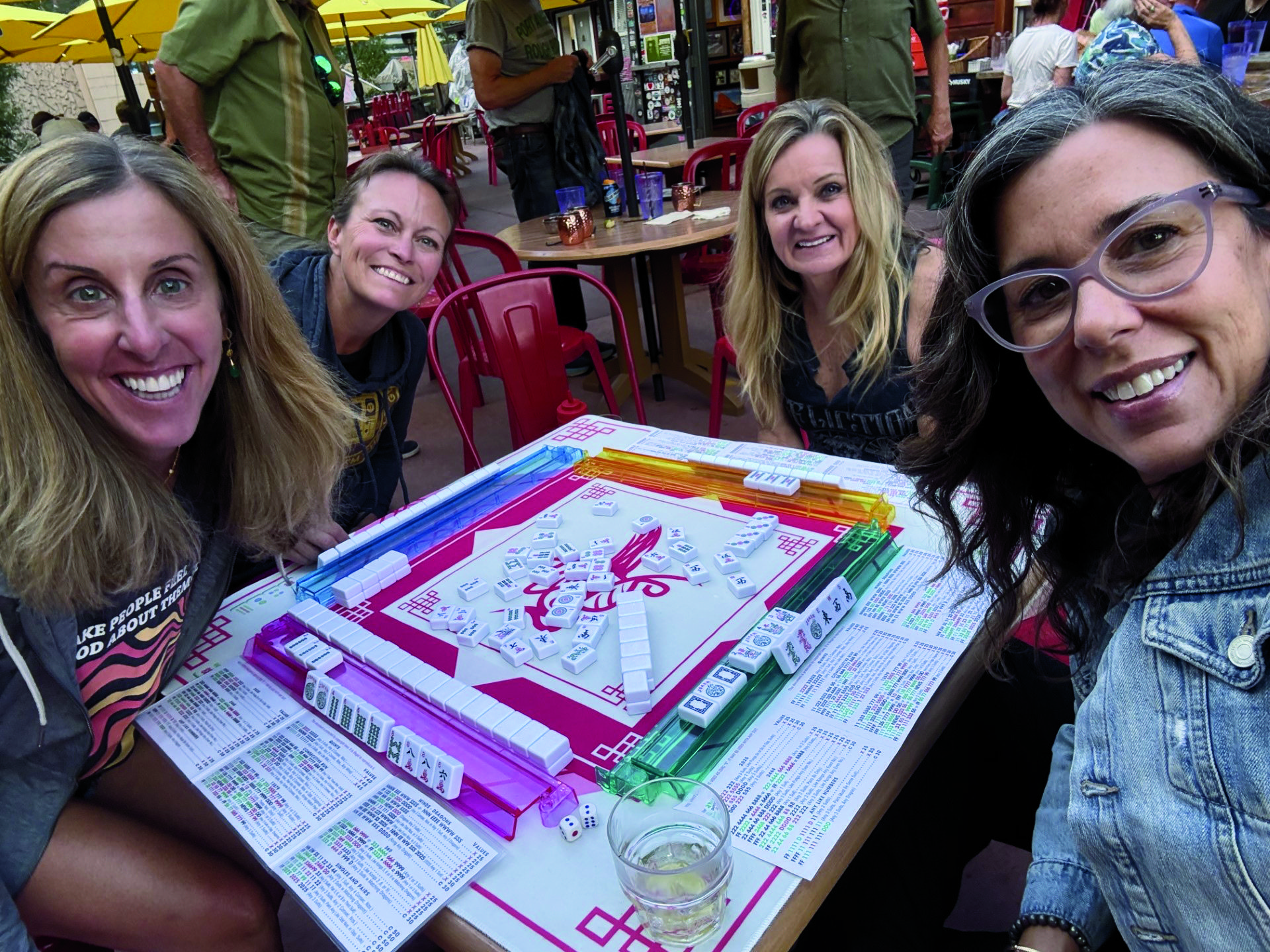
So, what is Mahjong? At its heart, it’s a tile-based game played by four people, with roots in 19th-century China and a fascinating journey to the United States in the early 1920s. The game enjoyed a roaring start here, faded for a time, and then found new life in 1947 when a group of Jewish women formed the National Mah Jongg League and introduced the standardized rules most Americans play by today. (Yes, the spelling is different, but the game is the same.) Mahjong is equal parts strategy, luck, memory and rhythm—think Gin Rummy, but with runs that stretch into a deeply satisfying 13 tiles. Each March, the National Mah Jongg League releases a brand-new card featuring 50 possible hands, and those are the hands we play—and obsess over—for the entire year. What I love most, though, are the sensory pleasures: the weight of the tiles, the bright colors, and that unmistakable click-click-click that signals you’re exactly where you’re supposed to be.
Mahjong has quietly become one of my favorite anchors in the week—something steady and comforting to look forward to as schedules shift and seasons change. There’s something deeply reassuring about being expected at the table, about knowing that if my chair were empty, someone would notice. As we shuffle tiles, set up racks, and laugh our way through inevitable misplays, the formality between strangers gently falls away. Conversations unfold between hands, trust builds in the familiar rhythm of the game, and before you realize it, acquaintances have turned into friends.
It feels especially right in a mountain town like ours, where a slower pace and intentional gathering are already part of the culture. Mahjong asks us to put our phones down, sit across from one another, and enjoy the simple, analog pleasure of being fully present—trading notifications for conversation and the satisfying sound of tiles meeting tile. It works just as well around a living room table as it does in a community center, a cozy café corner, or even a bar. And if you’re feeling curious (or just Mahjong-adjacent), Cactus Jack’s will be offering Mahjong lessons starting in March. Pull up a chair.