
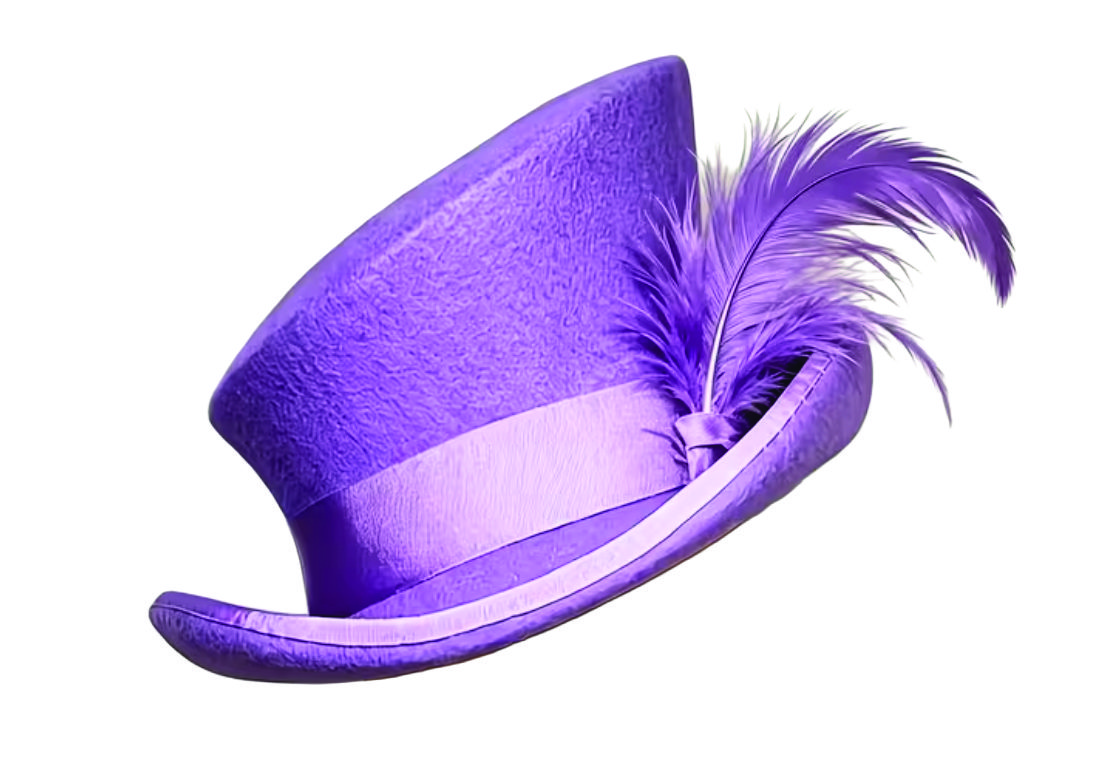
Without hats, there is no civilization. —Christian Dior
When alpine hikers discovered the frozen body of a 5,300-year-old murder victim high in the Austrian Alps in 1991, scientists were ecstatic. There, melting out of an ice-blue glacier, was the world’s oldest hat.
Stitched together from scraps of bear skin, Otzi the Iceman’s hat was proof positive that folks in the Copper Age liked a toasty bean. Before Otzi, the oldest known hat dated back a mere 3,000 years, a broad, flat chapeau woven of horse hair and plant fibers that emerged from a Scottish bog in 1953.
“Be they banker or builder, a fellow would no sooner leave home without a hat than without his pants.”
Although physical examples have been frustratingly hard to come by, anthropologists have long believed that people have been wearing hats for as long as they’ve been wearing anything else. Going by the artistic record, hats have been an essential element of the human ensemble since the last Ice Age, at least. A 30,000-year-old Paleolithic figurine called the Venus of Willendorf appears to be crowned with a close-fitting knit cap. Bronze Age Sumerian sculpture is replete with thick-brimmed headwear. Egyptian tomb paintings depict farmers wearing wide conical straw hats.
The first hats were fashioned to protect against cold, or to shade from the sun. It didn’t take long, however, before hats began serving a more social function, that of indicating status. While the Roman man-on-the-street didn’t wear a hat around town, he might announce himself a foreigner by sporting a wide-brimmed “petasos” while traveling abroad. Freed slaves of the empire typically wore a “pileus,” a simple felt hat indicating their independent condition.
By the Middle Ages, hats had become an absolute barometer of rank. For most women, a simple linen coif signaled humility and subservience. Peasant men wore sturdy, homely wool hats. Tradesmen wore hoods with an extending cape. Scholars wore feathered berets. Nobles of both sexes preferred the outlandish chaperon, an elaborate cousin of the Moorish turban featuring a long tail draping stylishly over the shoulder. Meeting a stranger, one could tell at a glance whether to grovel at their feet or hit them with a stick.
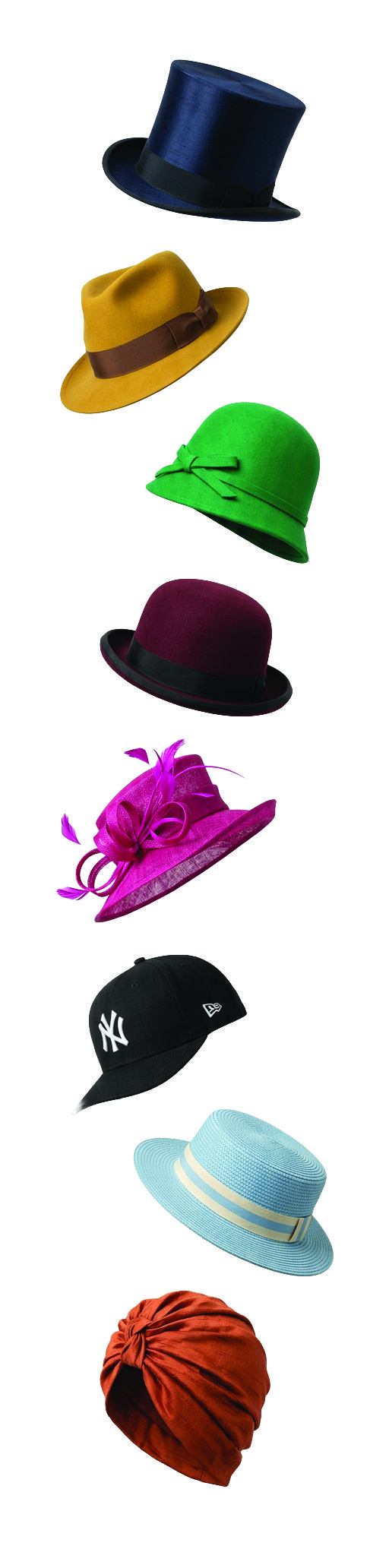
Europeans wore their mania for headgear into the New World. What would the Pilgrim be without his buckled capotain, or the Patriot without his trusty tricorne? Westward expansion was accomplished beneath rugged Stetsons, trim Derbys and modest bonnets. By the 20th century, men’s fashions leaned into Homburgs and Fedoras, while women turned heads with oversized Merry Widows, casually chic Cloches and practical Turbans. Men with pretensions wore a top hat. Men with calloused hands wore an Ivy cap. Pretty much everybody wore something on their noggin, and they wore it all the time. Be they banker or builder, a fellow would no sooner leave home without a hat than without his pants. Like Charlie Chaplin’s plucky Little Tramp, a man with a hat was a man with dignity.
So, what happened? We still wear hats for the most ancient reason—protection from the elements—and we’ll stipulate that cowboy hats are still very much in fashion down to the honky-tonk, but hats as daily apparel, necessary components of a proper civilian wardrobe, have gone whither the woodbine twineth. How did we become a hatless society? Why, after long centuries of Tams and Trilbys, Pork Pies and Panamas, Cattlemen and Cavaliers, are pampered American crania now exposed to brute Nature and the scrutinies of strangers?
There are theories.
“As America increasingly took to the wheel, more and more hats were left at the curb.”
One is that America’s passion for hats went South in 1961 when John F. Kennedy attended his inauguration bare-pated. While it’s true that JFK liked to project a modern, youthful image and considered hats “old fashioned,” headwear had been taking a header since the early 1950s, and blaming the industry’s decline on presidential neglect is a bit of a stretch.
Others suggest that the millions of men and women who spent WWII wearing helmets and uniform covers were simply sick of hats. Associating hats with the war, they chose to proceed in civilian life without them. While this proposition has merit, one might as easily argue that people accustomed to wearing hats and keen to shed military lids could find civilian hats a welcome antidote to steel pots and garrison caps. It should also be mentioned that general military conscription had a powerful homogenizing effect on the population, and it’s not impossible that as class divisions weakened, the hats that identified them fell out of favor.
America was getting pretty comfortable by the ’50s, and one theory that deserves consideration is climate control. People who spend little time cold have little need for warm clothing. This would also explain why gloves and scarves aren’t the universal accessories they used to be. Still, habits of habiliment are hard to break, and it seems likely that more practical factors may have been in play.
Probably the best explanation for the downfall of the hat is the rise of the automobile. One can’t easily climb into, or out of, a car with a hat on. And since most hats were too tall to wear inside of the family sedan, folks were left with the choice of either finding a place to park them somewhere within the driving compartment, or holding them in their lap. While that may sound like a fairly small problem, it would present for the hatted a persistent annoyance most efficiently avoided by deep-sixing the hassle-some headpiece. As America increasingly took to the wheel, more and more hats were left at the curb.
Which, curiously enough, seems to have fueled the ascendency of the ubiquitous hat-lite. Baseball caps have become the preferred headwear of those still wishing to cloister their coconut. Cheap to the point of disposable and endlessly customizable, today’s ball cap is a mass-produced expression of individuality, and it can be worn in the car. Whether or not it lends dignity is a matter of opinion.
Personally, I would never want to be a member of any group where you either have to wear a hat, or you can’t wear a hat.
—George Carlin