
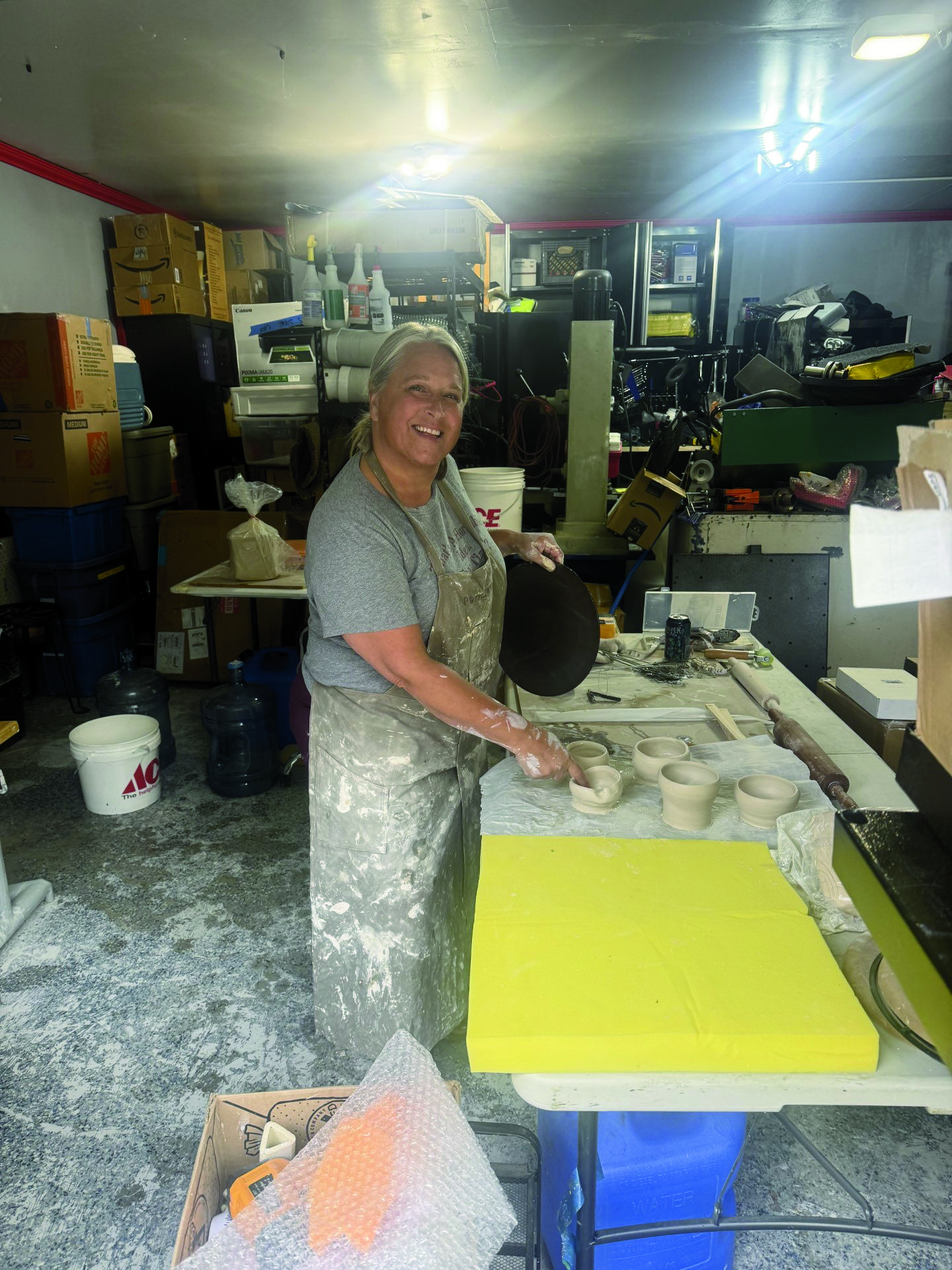
I had a charming inaccurate vision of what it was like to sling pottery. “Ghost” (the movie) references aside, I pictured myself gracefully sitting at the wheel, hands moving with artistic confidence, effortlessly transforming a lump of clay into a masterpiece worthy of a trendy artisan market. Perhaps birds would sing. Perhaps someone would whisper, “She’s a natural.”
To be honest, my first few attempts weren’t half bad. I made a couple of vessels that actually looked like mugs. They stood upright, held water, and didn’t resemble anything excavated from an archaeological dig. Even my close friend who was teaching me commented on my natural abilities. I left the garage feeling suspiciously talented.
Naturally, this is where everything fell apart. Armed with a dangerous amount of confidence and very little actual skill, I approached my next pottery session as if I were preparing for my own exhibit at the Smithsonian. The clay had other ideas. The wheel spun. The walls collapsed. Mugs became bowls, then plates, then sopping wet blobs. It was a humbling experience.
“As it turns out, learning pottery and living life have a lot in common.”
As it turns out, learning pottery and living life have a lot in common. Neither goes exactly as planned, both are messier than expected, and success often comes after a healthy dose of humility.
The first lesson every potter learns is centering the clay. Before you can make a bowl, mug or vase, the clay must be perfectly centered on the wheel. This sounds simple until you try it. The clay fights back. It wobbles. It shakes. It behaves like a toddler refusing to put on shoes.
Life requires centering, too. Whenever I feel overwhelmed, stressed, or one minor inconvenience away from moving to a remote island, I realize I’ve lost my center. Maybe I’m trying to do too much. Maybe I’m worrying about things I can’t control. Whatever the reason, life becomes noticeably smoother when I stop spinning out of control and reconnect with what matters most. Sometimes, that’s talking with friends, exercising, or just walking barefoot in the fluffy grass outside my window.
As it turns out, pottery is basically a master class in managing pressure. Use too much pressure and your beautiful bowl instantly collapses into what appears to be a clay pancake. Use too little pressure and nothing happens. The clay just sits there, judging you.
Life operates similarly. Too much pressure and we burn out. Too little pressure and we never grow. The trick is finding that sweet spot where we’re challenged but not crushed. Easier said than done, of course. If humans came with an instruction manual, this chapter would probably be missing.
Then, there are mistakes. Oh, the mistakes. A pottery studio is a graveyard of good intentions. Bowls collapse. Handles fall off mugs. Pieces crack in the kiln after hours of work. At first, these failures feel devastating. I’d spend an hour making something only to watch it fold in on itself like a deflated birthday balloon.
As my sweet friend helped me finish one frustrating mug with such patience, he informed me that every experienced potter has a collection of disasters. The difference is that they understand something beginners don’t: Failure isn’t the opposite of success. It’s part of the process.
Life has a way of hitting the same mark. Most of us have our own collection of collapsed bowls. Relationships that didn’t work out. Jobs that weren’t the right fit. Plans that went gloriously off the rails. At the time, these moments felt like proof that we’ve failed. Looking back, they’re often the very experiences that taught us what we needed to know.
Pottery is also an exercise in patience, which is unfortunate because patience is not one of my natural gifts (says the preschool teacher). You can’t rush clay. After throwing a piece, it must dry. Then it must be trimmed. Then fired. Then glazed. Then fired again. The entire process takes like 1,000 days. As someone who occasionally gets annoyed when a microwave takes longer than 60 seconds, this has been challenging.
Life, unfortunately, follows the same rules. Growth takes time. Healing takes time. Learning takes time. Most worthwhile things take far longer than we’d prefer. We live in a world obsessed with instant results, but pottery reminds us that transformation is often happening even when we can’t see it.
Perhaps my favorite lesson from pottery is learning to appreciate imperfection. No handmade mug is exactly symmetrical. The rim might lean slightly. The glaze might run in unexpected ways. Fingerprints from the maker may remain visible. Those little irregularities are what make the piece unique.
The same is true of people. Most of us spend years trying to smooth out our imperfections. We want to be more organized, more successful, more attractive, more productive, or somehow more everything. Yet the people we love most are rarely perfect. They’re wonderfully human. They’re quirky, flawed, and occasionally ridiculous. In other words, they’re handmade.
The trick, I’ve learned, is not expecting perfection. The trick is showing up anyway, getting my hands dirty, laughing at my mistakes, and resisting the urge to throw a rebellious bowl across the room.
I mean, aren’t we all just unformed lumps of possibility, trying our best to stay centered while the world spins around us? We wobble. We reshape ourselves. We start over more times than we’d like to admit. And if we’re lucky, after a little pressure, a lot of patience, and perhaps a few trips through the kiln, we become something both useful and beautiful—slightly imperfect, uniquely our own, and strong enough to hold whatever life pours into us.