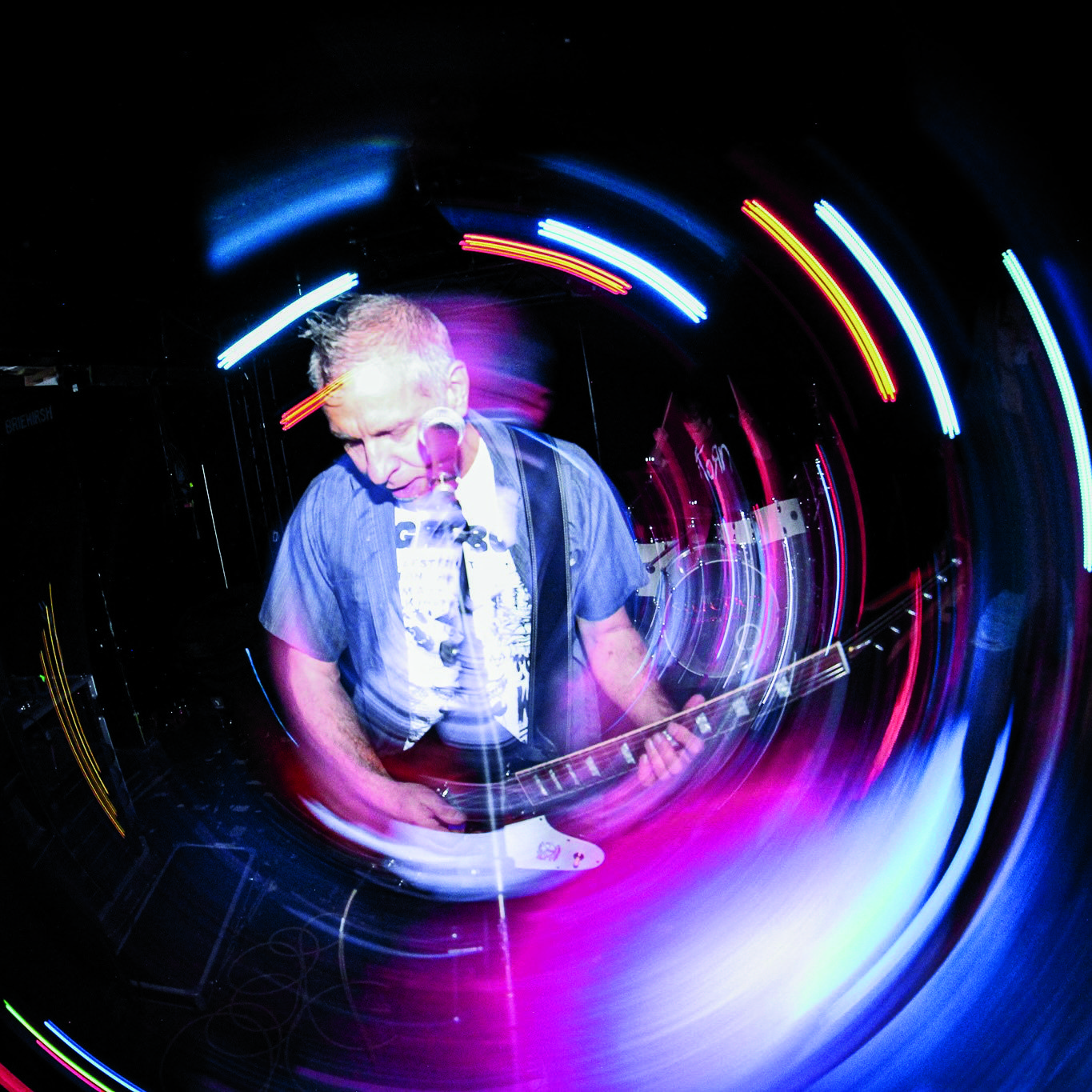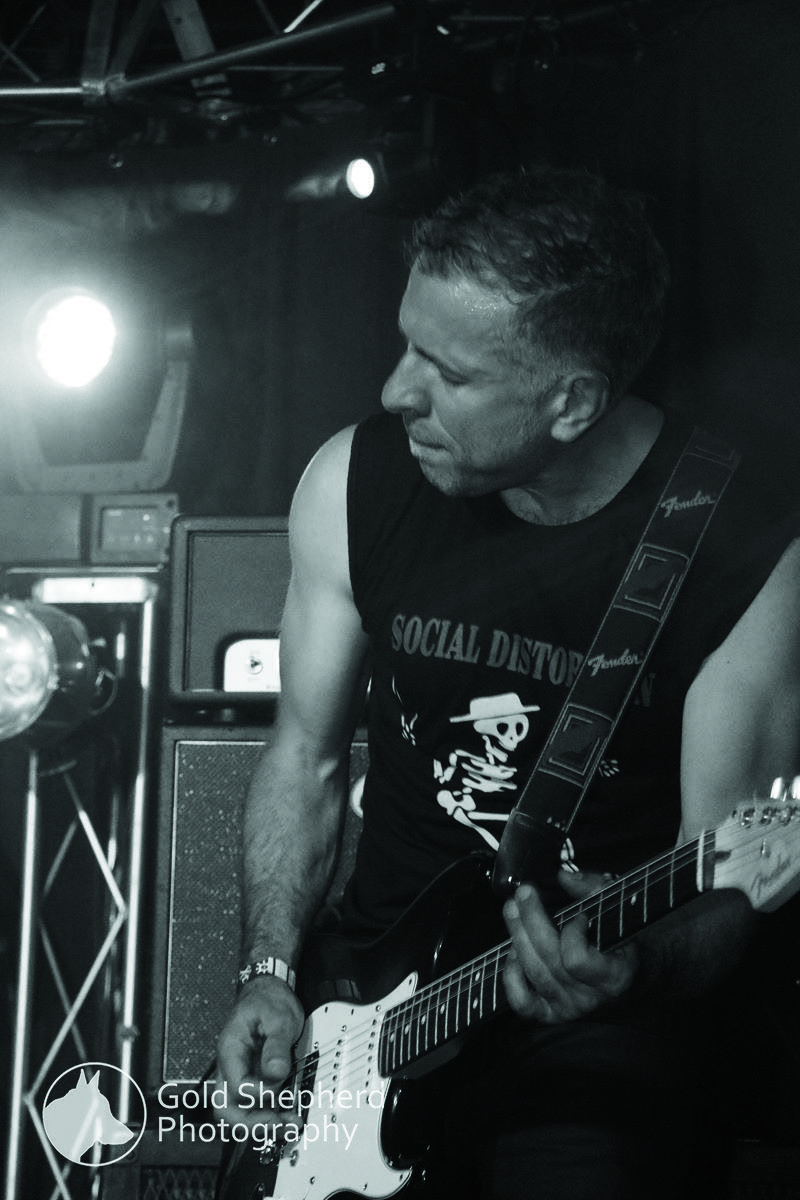
Pete Risano is a guitarist with a passion for alternative rock and improvisation. He currently lives in Pine, Colorado and occasionally drops down into The Little Bear to play gigs with his friend and bandmate, Kris Donahue.
Pete met Kris on a random Sunday in 2024 at The Bear. She was performing with the band she was with at the time and as soon as he heard her sing, Pete knew her talent was off the charts. Pete joined the band within a month and they’ve been working together since. Currently, they’re looking for a drummer and bassist to round out their already established ’90s alt-rock project, Don’t Call Me Daughter (a nod to both the Pearl Jam song and Kris being the daughter of innovative guitarist Jerry Donahue). Targeting corporate functions and high-end private celebrations, they will also be adding a male co-lead vocalist in the near future.
The first thing I learned from Pete during our conversation is that he considers jamming and improvisation to be two very different things. Jamming exists within a set framework: a certain key, a melody, a repeating motif or verse. A jam lives within a song or tune that already exists. You might wander off for a while, but the foundation remains. Improvisation, by contrast, is all about listening, feeling, finding your voice, and having a conversation with the other musicians. It’s an entire exploration of a loose idea, a journey where the final destination is unknown.
“I want to own and represent the music… truly do it justice.”
Playing what you know is safe. As soon as you start improvising, you start taking risks, and for Pete, that’s where the real magic happens. That’s partly why he loves Miles Davis, who had a knack for discovering bold musicians and pushing himself and his collaborators to unlock the full potential of a sound. This kind of risk only pays off through deep listening: communicating seamlessly as a team through notes alone, without words or often even eye contact. While Pete doesn’t play a lot of jazz now, he studied jazz at William-Patterson college and attributes much of his style to jazz techniques and energies.
In the last decade, Pete has been in the Tim Mercer band (timmercermusic.com) and tribute bands for Pearl Jam and Foo Fighters, bringing a jazz-like spontaneity to alt-rock. Rather than focusing on pitch perfection or trying to replicate someone’s exact riffs, Pete tells me that a good tribute is about “bringing as much of the original attitude of the band as you can.” Spontaneous energy and flow is crucial for capturing an audience’s attention and making a memorable experience. “I want to own and represent the music… truly do it justice,” he explains. By putting his own energy into classic, well-loved songs, he breathes life into the music, pushing forward its story, personality, and relationship with ever-changing artistic and musical landscapes.
This idea leads Pete into a story about a gig he played in his youth. The audience at the bar was loud and distracted, and no matter what the band did, they couldn’t hold the crowd’s attention. So Pete decided to do something about it: As the band fell into a breakdown leading up to his guitar solo, he quirked his eyebrow to let them know he had mischief in mind. Then, he pitched the guitar up a half-note and began playing his guitar solo loudly and purposely off-key. He played one note for three annoyingly long bars before ending the solo back in key. The crowd immediately felt the disruption and dropped their conversations to look up at him disapprovingly. His decision to do something unexpected and risky helped him connect to the crowd in a funny and unexpected way, and they actually began to pay more attention afterward. “Music is full of humor, beauty, and love,” Pete grins, and it’s all about finding and making those little moments of magic.
What Pete finds really fun about playing in bands is “you don’t always have to take it too seriously… and you can get away with a lot.” When he’s playing tribute to songs and artists that people already know and love, he doesn’t have to play note-for-note perfectly. In this space, with these expectations, there’s an exciting freedom. He likes to experiment and explore his sound with a depth of performance that offers rich layers of experience every time he plays a set.
Playing on stage isn’t Pete’s only experimental space, and I bet he’d argue that it isn’t the most important, either. Between the ages of 15-20, and again in later years, he spent most Sundays improvising with a group of friends. Often, bassist Marc Harris would start with a loose idea, and the ‘band’ (featuring Mike Pedula on guitar and Jim Hall or Christopher White III on drums) would slowly build up around his framework. These sessions were a gateway into flow state. Most artists are familiar with the idea of flow, often called “the zone” among athletes. Pete regards flow as a state of being “hyper present and entirely open.” He wonders if flow state allows one to “access all that energy that we think of as past and present but which is actually always there, all around us.” Pete lives for the moments when he shares flow state with other musicians. When you have a group of musicians whose instruments are an extension of their voice and soul, the possibilities are endless. “Sometimes it’s a train wreck… sometimes it feels sublime,” he tells me. “Like life.”
Learn more about Pete’s projects at dontcallmedaughterband.com, or reach out to him for collaborations at [email protected]