I signed up for a mindful drumming class the way I sign up for many things lately: with equal parts hope and mild suspicion. The listing promised rhythm, breath, and “embodied awareness.” It did not mention that I’d be standing the entire time, wielding large sticks, hitting a massive drum in a room full of strangers from 6:30 to 8 at night—prime pajamas-and-Netflix hours. Still, something in me said yes. Or maybe something in me was just tired of saying no.
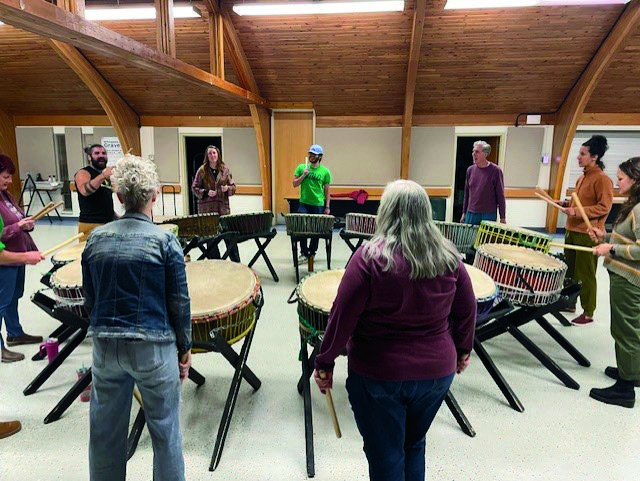
The first evening, I arrived early, because anxiety loves punctuality. Outside, the sky was doing that slow dusk thing—the day loosening its grip. I found the drum space inside the local community center. The room itself held no kindness, just a vacuous space likely used for elementary dance classes, BINGO or senior crafting.
Large drums stood upright in a circle, each one paired with a set of thick sticks that looked more ceremonial than musical. These were not polite little bongos. These were statement drums. I took my place and immediately became aware of my body—how I was standing, how my shoulders were holding on to secrets, how my hands didn’t know what to do yet.
Enter Max, our instructor.
Max had the calm confidence of someone who knows exactly why he’s there. Buff arms (respectfully distracting), hair pulled back into a man bun that suggested both strength and good conditioner, and eyes that were unmistakably kind. When he smiled, the room softened. It wasn’t a “welcome to class” smile. It was more like, I see you, and you’re safe to be human here.
He didn’t start by telling us what to do. He started by asking us what the definition of mindfulness was. After several partial truths, he emphasized the full definition: “Mindfulness is present moment awareness without judgment.” In other words, do not allow your head to get in the way of your drumming.
“My mind felt spacious, like someone had opened a window.”
We practiced some deep inhales through the nose and loud exhales that took the day’s toxins with them. Feet planted. Knees soft. Shoulders dropped. Inhale like you mean it. Exhale like you’re finally allowed to let something go. I realized how shallow my breathing had been all day—maybe all week. Standing there, sticks resting lightly in my hands, I could feel myself arriving.
Then, we began.
The first strike of the drum was… assertive. These drums do not whisper. They respond. The sound traveled up my arms and straight into my chest, like a reminder that I have a body and it wants to be included. Max demonstrated a simple rhythm, then stepped back, letting us find it together. Bum, bum, bum, dunt, dunt, dunt, bum, bum. The room filled with sound—low, grounding, almost ancient. I felt it in my feet. In my ribs. In places I hadn’t checked in on lately.
Standing for 90 minutes turned out to be part of the magic. There was no slumping into comfort, no disappearing from the waist down. My feet rooted me. My legs protested briefly, then gave in. My shoulders loosened. The rhythm and my breath started negotiating with each other until they reached an agreement.
At some point, Max invited us to close our eyes. This felt bold. Slightly unhinged. But I did it anyway. And the moment I did, something extraordinary happened: my thoughts took a seat. With my eyes closed, the world narrowed to sensation. I noticed the rise and fall of my breath, the weight of the sticks, the steady, hypnotic boom of the drum. Time got fuzzy. The to-do list lost its voice. There was a stretch of minutes (maybe seconds?) where nothing else mattered. Not the past. Not the future. Not even whether I looked cool (I absolutely did not).
Euphoria crept in quietly. Not fireworks, but a deep, clean joy; the kind that spreads slowly and says, “Oh. This is what calm feels like.” My nervous system seemed genuinely surprised. Like, “Wait, we can do this?”
Over six sessions, that feeling became something I trusted. Each class from 6:30 to 8 became a sacred pocket of time where the outside world had to wait its turn. We learned new rhythms, layered beats, moments of full-bodied power followed by near silence. Max guided with ease—correcting gently, smiling often, reminding us to breathe when we forgot (which was frequently).
And we became a small, lovely tribe. Familiar faces turned into names. Names turned into knowing smiles. New friends formed the way they often do when people stand together and share something wordless. There’s a special kind of intimacy that comes from drumming next to someone with your eyes closed, trusting they’ll keep the beat while you float for a moment.
What surprised me most was how I felt afterward. Each night, I left calm in a way that felt earned. My body was tired in the good way. My mind felt spacious, like someone had opened a window. The drive home was quieter. Sleep came easier. The usual mental chatter had been temporarily drummed into submission.
By the final session, standing behind that drum felt less like stepping out of my comfort zone and more like stepping into something essential. I understood then that the peace I felt wasn’t coming from Max (though, credit where credit is due), or the drums, or even the group. It was coming from my willingness to show up fully. To stand. To breathe. To close my eyes and trust the rhythm.
Six sessions didn’t change my life in a dramatic, montage-worthy way. But they changed something deeper. They reminded me that stillness doesn’t always look quiet. Sometimes it sounds like a room full of drums, played in unison at dusk, while the rest of the world waits politely outside.
And sometimes peace arrives with sticks in your hands, your feet planted firmly on the floor, and the sudden realization that—right now—you are exactly where you’re supposed to be.
If you’re interested in participating in this yourself, visit rhythmetrix.com for information.